The skies are about to get a whole lot smarter, faster, and more integrated. For decades, the Lockheed Martin F-22 Raptor and F-35 Lightning II have epitomized cutting-edge airpower, defining the "fifth generation" of fighter aircraft with their stealth, speed, and networked capabilities. But as the geopolitical landscape evolves and technology leaps forward, a new class of air superiority platform is on the horizon: the 6th generation. This isn't just an upgrade; it's a paradigm shift, fundamentally rethinking how air combat is waged. Understanding the comparison: 5th vs. 6th generation fighters is crucial for grasping the future of aerial warfare.
Think of it as moving from a highly intelligent, specialized combat vehicle to an intelligent, adaptable system that can operate autonomously, collaborate with swarms of drones, and wield weapons we've only seen in science fiction.
At a Glance: What Defines the Next Frontier?
Before we dive deep, here’s a quick snapshot of the core differences:
- 5th Gen: Focuses on passive stealth (shaping, materials), supercruise (sustained supersonic flight without afterburners), advanced sensor fusion, and networked operations, with the pilot as the central decision-maker.
- 6th Gen: Builds on 5th-gen capabilities by adding unprecedented AI-driven autonomy, optional manned or unmanned operation, active stealth (adaptive camouflage, electronic cloaking), directed energy weapons (lasers), hypersonic missiles, and full-fledged manned-unmanned teaming (MUM-T) with loyal wingmen and drone swarms.
- Key Shift: From human-centric, passively stealthy platforms to AI-augmented, actively stealthy, highly autonomous, and deeply integrated combat systems.
The Genesis of Generations: A Brief Flight Through History
To truly appreciate the leap to the 6th generation, it helps to understand the historical context of fighter classification. It's not a perfectly linear science, with various nations and historians offering slightly different takes. However, the core idea is simple: each "generation" marks a significant technological jump that fundamentally changes aircraft design, performance, and combat philosophy.
We started with the piston-powered marvels, then the jet age brought us straight wings (1st gen) and swept wings for transonic speeds (2nd gen). The post-Korean War era ushered in Mach 2 performance, radar, and early missiles (3rd gen), rediscovering the multi-role fighter.
Then came the 4th generation, a true revolution: fly-by-wire controls for incredible maneuverability, composite materials, thrust-to-weight ratios greater than one, advanced digital avionics, and even early stealth concepts. Aircraft like the F-16 and Su-27 became legends here. The "4.5 generation" further refined these, introducing technologies like AESA radar, enhanced stealth features, sensor fusion, and even limited supercruise, essentially bridging the gap to what came next.
The Rise of the Fifth Generation: Stealth, Sensors, and Situational Awareness
The 5th generation didn't just add new features; it fundamentally integrated them into a cohesive whole, driven by advancements in digital computation and mobile networking. These aircraft are more than just fighters; they are airborne command, control, and communication (C3) nodes.
Defining Characteristics of 5th Gen Fighters:
- Passive Stealth Technology: This is perhaps the most defining characteristic. Through meticulous shaping (faceted surfaces, integrated weapons bays) and radar-absorbent materials (RAM), 5th-gen fighters significantly reduce their radar cross-section (RCS), making them incredibly difficult to detect, track, and target with traditional radar systems. The goal is to "see without being seen."
- Supercruise: The ability to sustain supersonic flight without relying on afterburners. This allows for faster transit, extended combat time, and less fuel consumption at high speeds, giving an edge in maneuvering and positioning.
- Sensor Fusion: A game-changer. Rather than presenting pilots with raw data from individual sensors (radar, infrared, electronic warfare), 5th-gen aircraft fuse all this information into a single, coherent, and easily digestible picture. This dramatically enhances the pilot's situational awareness, allowing them to make faster, more informed decisions in complex combat environments.
- Network-Centric Warfare: These aircraft are designed to be integral nodes in a wider network. They can share their fused sensor data with other platforms (aircraft, ground stations, ships), dramatically increasing the effectiveness of the entire force. It's about collective awareness and collaborative targeting.
- Advanced Avionics & Cockpit Design: From touch-screen displays to advanced helmet-mounted systems, the cockpit is designed to reduce pilot workload and enhance interaction with the aircraft's sophisticated systems.
- High Maneuverability: While stealth is paramount, 5th-gen fighters still boast exceptional agility, thanks to powerful engines and sophisticated flight control systems.
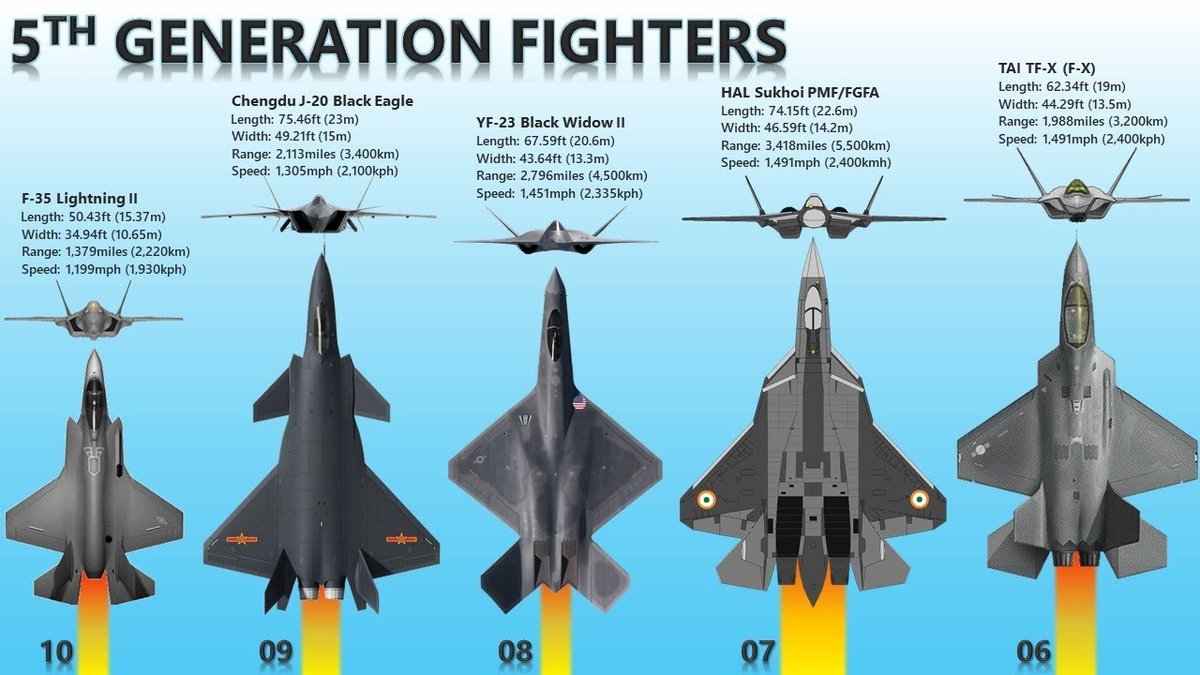
Examples: The F-22 Raptor, F-35 Lightning II, Chengdu J-20, Shenyang J-35, and Sukhoi Su-57 are the most prominent examples, each representing their nation's interpretation of these core capabilities. They are, for now, the apex predators of the sky, but their reign is already being challenged.
The Dawn of the Sixth Generation: Beyond the Pilot, Beyond Traditional Stealth
The transition to 6th-generation fighters isn't merely an incremental upgrade. It's a fundamental reimagining of airpower, driven by the realization that even 5th-gen stealth might eventually be countered by emerging detection technologies (like quantum radar or advanced multi-spectral sensors). The future demands platforms that are not only faster and stealthier but also exponentially smarter and more adaptable.
The 6th generation will lead the charge into "next-gen airpower," blurring the lines between manned and unmanned, kinetic and non-kinetic warfare. If 5th-gen fighters are the ultimate combatants, 6th-gen fighters are the ultimate combat orchestrators and multi-domain effectors.
How 6th Gen Fighters Are Redefining Air Superiority:
- AI-Driven Decision-Making & Combat Autonomy: This is perhaps the most revolutionary aspect. While 5th-gen pilots are supported by advanced avionics, 6th-gen aircraft will feature highly sophisticated Artificial Intelligence that can make tactical decisions in fractions of a second. This allows for semi-autonomous or even fully autonomous missions, reducing the cognitive load on human operators and enabling complex maneuvers or responses faster than a human could react. Think of AI managing advanced threat analysis, targeting, and electronic countermeasures in real-time.
- Optional Manned/Unmanned Operation (OMUO): A 6th-gen fighter might be flown by a human pilot for certain missions, or it could operate entirely autonomously for high-risk or long-duration sorties. This flexibility optimizes mission profiles and reduces risk to human life.
- Active Stealth & Adaptive Camouflage: Passive stealth (shaping and materials) will remain, but 6th-gen aircraft will add active measures. This includes electronic cloaking to disrupt radar, and potentially even "adaptive camouflage" that changes the aircraft's visual or thermal signature in real-time to match its environment, deceiving multi-spectrum sensors.
- Manned-Unmanned Teaming (MUM-T) & Loyal Wingmen: While 5th-gen aircraft might have experimented with drone integration, 6th-gen platforms will fully embrace MUM-T. A single manned fighter could command a swarm of highly capable, semi-autonomous "loyal wingmen" drones. These drones could extend sensor reach, carry additional weapons, act as decoys, jam enemy systems, or even perform coordinated attacks, dramatically expanding the manned aircraft's operational envelope and survivability.
- Directed Energy Weapons (DEWs) & Hypersonic Missiles: The introduction of high-energy lasers and microwave weapons could revolutionize air-to-air and air-to-ground combat. Lasers offer precision, speed-of-light engagement, and essentially infinite "ammunition" (as long as power holds out), capable of neutralizing incoming missiles or engaging targets silently. Hypersonic missiles, traveling at Mach 5 or greater, will make interception incredibly difficult, fundamentally shifting offensive strike capabilities.
- Advanced Electronic Warfare (EW) & Cyber Capabilities: 6th-gen fighters will be paramount in the electromagnetic spectrum, with integrated EW systems capable of sophisticated jamming, spoofing, and even cyber attacks against enemy networks and systems. Information dominance becomes a weapon in itself.
- Adaptive & Open Architectures: Unlike previous generations, 6th-gen platforms are envisioned with modular, open architectures, allowing for easier software and hardware upgrades. This "plug-and-play" approach means the aircraft can evolve rapidly to integrate new technologies or adapt to emerging threats without costly, complete redesigns.
Comparing 5th vs. 6th Generation Fighters: A Head-to-Head View
Let's break down the core distinctions in a direct comparison.
| Feature | 5th Generation Fighter | 6th Generation Fighter |
|---|---|---|
| Stealth Philosophy | Passive Stealth: Primarily shaping & RAM to reduce RCS. | Active Stealth: Passive stealth + electronic cloaking, adaptive signature control. |
| Autonomy & AI | Pilot-centric, AI as assistant for sensor fusion & decision support. | AI-driven combat autonomy, optional manned/unmanned (OMUO), AI makes tactical decisions. |
| Manned-Unmanned Teaming | Limited/experimental drone integration (auxiliary roles). | Full-fledged MUM-T with loyal wingmen & drone swarms as integral combat partners. |
| Primary Weapons | Advanced kinetic weapons (BVR missiles, precision-guided munitions). | Directed Energy Weapons (lasers), hypersonic missiles, advanced kinetic, cyber effects. |
| Network-Centricity | Highly networked, data sharing for situational awareness. | Deeply integrated multi-domain networking, acting as a command node for disparate assets. |
| Situational Awareness | Advanced sensor fusion for superior pilot SA. | AI-enhanced SA, potentially leveraging distributed sensor networks across a drone swarm. |
| Survivability | Relies on stealth, maneuverability, EW. | Active stealth, advanced EW, MUM-T for distributed risk, rapid decision-making via AI. |
| Architectural Design | Integrated, less flexible for rapid upgrades. | Modular, open-system architecture for rapid tech insertion and adaptation. |
| Primary Role Focus | Air superiority, multi-role (strike, recon). | Air dominance across all domains (air, space, cyber), force multiplier. |
The Global Race to Dominance: 6th Generation Programs
The development of 6th-generation fighters isn't confined to a single nation. Major powers and alliances worldwide are pouring resources into these ambitious programs, each with its own specific focus and timeline. Understanding these initiatives helps us explore sixth generation aircraft and their future impact.
United States
The U.S. has two major efforts underway:
- NGAD (Next Generation Air Dominance): This isn't just an aircraft; it's a "system of systems" envisioned by the U.S. Air Force. NGAD aims to replace the F-22 and potentially supplement the F-35, focusing on a multi-role, modular platform capable of advanced stealth, AI-driven combat, and directed energy weapons. It emphasizes persistent reach, survivability, lethality, and adaptability in contested environments.
- Navy’s F/A-XX: Complementing NGAD, the F/A-XX is the U.S. Navy's parallel program, designed for carrier-based operations. It will share many of NGAD's core technologies but will be optimized for the unique demands of naval aviation, focusing on advanced capabilities for air superiority and strike missions from aircraft carriers.
Europe
Two major collaborative programs are shaping the future of European airpower:
- FCAS (Future Combat Air System): A joint Franco-German-Spanish initiative, FCAS (known as SCAF in France) is ambitious. It centers around a New Generation Fighter (NGF) that will act as a central node in a broader "system of systems," integrating manned aircraft with autonomous drones, next-generation missiles, and a collaborative combat cloud. The emphasis is on networked operations and advanced combat teaming.
- Tempest: Led by the UK, in collaboration with Italy and Sweden, Project Tempest is another significant European 6th-generation effort. It stresses manned-unmanned teaming, a highly modular design for easy upgrades, advanced electronic warfare capabilities, and a pilot-centric yet AI-augmented interface. Like FCAS, Tempest aims to deliver a multi-domain combat system, not just a single aircraft.
China
While officially less transparent, China has clearly hinted at its own 6th-generation development beyond the J-20. Given their rapid advancements in stealth, AI, and drone technology, it's highly probable that they are pursuing a similar path, likely emphasizing AI integration, networked operations, and advanced counter-stealth capabilities.
Russia
- MiG-41 (PAK DP): Russia's entry into the 6th-generation race, often referred to as the Prospective Aviation Complex for Long-Range Interception (PAK DP). Touted as an interceptor capable of hypersonic speeds and even operating in near-space environments, the MiG-41 aims to succeed the MiG-31. Details are scarce, but it's expected to feature advanced stealth, new weapons, and possibly AI integration.
The Unseen Hurdles: Challenges and the Road Ahead
Developing 6th-generation aircraft isn't just about dreaming up new technologies; it's about making them work together seamlessly in the most hostile environments imaginable. The challenges are immense:
- Technological Integration: Weaving AI, DEWs, MUM-T, and active stealth into a single, cohesive, and reliable platform is an engineering marvel in itself. Each component must communicate flawlessly and respond instantaneously.
- Robust AI Systems: Creating AI that can make ethical, effective, and reliable combat decisions in unpredictable scenarios is incredibly complex. Trust in autonomous systems will be paramount.
- Resilient Stealth: Can active stealth technologies truly stand up against equally advanced, multi-spectral detection systems being developed by adversaries? The arms race continues.
- Cost and Scalability: These platforms will be astronomically expensive to develop and produce. Balancing cutting-edge capabilities with the need for a sufficient fleet size will be a constant tension.
- Ethical Implications: The widespread use of AI-driven combat autonomy and loyal wingmen raises profound ethical questions about accountability and the nature of warfare.
- Cybersecurity: As systems become more integrated and AI-driven, they also become more vulnerable to sophisticated cyberattacks. Protecting these platforms from digital infiltration will be a critical, ongoing battle.
The specific requirements for 6th-generation fighters are anticipated to crystalize around 2025, with initial operational capabilities likely emerging in the 2030s and beyond.
Beyond the Horizon: What the 6th Gen Means for Airpower
The comparison: 5th vs. 6th generation fighters reveals more than just technological advancements; it unveils a fundamental shift in military strategy. The 6th generation isn't just about faster jets or better sensors; it's about achieving multi-domain dominance through unprecedented integration of AI, autonomy, and advanced weaponry.
The pilot, while still a critical decision-maker, evolves into a mission commander, orchestrating complex operations with a fleet of autonomous wingmen. Air superiority will no longer be solely about individual aircraft performance but about the collective intelligence and coordinated action of an entire integrated combat ecosystem. We are entering an era where the battlespace extends beyond the visible, into the electromagnetic spectrum, and the realm of artificial intelligence. This next generation of airpower promises to be nothing short of transformative, redefining the meaning of air dominance for decades to come.